

PDRN (polydeoxyribonucleotide) is the tissue-repair molecule extracted from salmon DNA that powered South Korea’s famous “baby face” clinic treatments for years. Today, Korean lab innovations have shrunk and stabilized this clinical powerhouse into gentle, over-the-counter serums you can pat onto clean skin right at home. Here is what this viral K-beauty ingredient actually does, how it compares to in-clinic injections, and whether it deserves a spot in your evening routine.
- From Seoul Medical Spas to Daily Dropper Bottles
- What Salmon DNA Actually Does for Tired Skin
- Do Topical PDRN Serums Really Work Like Injections?
- Injections vs. Topical Serums: A Clear Comparison
- How to Layer PDRN in Your Daily Routine
- What to Check Before You Buy
- FAQ
- Where to buy — Sister Unice’s picks
- Sources
From Seoul Medical Spas to Daily Dropper Bottles
If you have followed Korean aesthetic trends over the last decade, you have likely heard whispers of yeon-eo jusa (연어주사), which translates literally to “salmon injection.” In Gangnam dermatology clinics, micro-injections of PDRN under brand names like Rejuran Healer became legendary among local actresses and busy brides preparing for wedding photos.
The goal was never to freeze muscles like Botox or fill volume like hyaluronic acid. Instead, dermatologists injected it across the face to trigger wound healing, boost collagen synthesis, and restore bouncy, resilient skin texture.
The catch?
In-clinic micro-needling or hand injections hurt quite a bit, require days of bumpy social downtime, and cost hundreds of dollars per session. Seeing how much people loved the cellular repair benefits, Korean beauty chemists worked on low-molecular-weight formulations and liposomal delivery systems so everyday consumers could reap the firming perks without needles.
What Salmon DNA Actually Does for Tired Skin
Hearing the words “salmon sperm DNA” on a skincare box can certainly make anyone pause. But the biology behind it is genuinely fascinating and grounded in decades of regenerative medicine.
Salmon DNA shares a remarkable 95% structural similarity to human DNA, meaning your skin cells recognize and tolerate it without triggering major inflammatory alarms. Skincare labs purify this DNA fragment down to tiny nucleotide chains that stimulate skin cell renewal and activate tissue repair receptors.
- Accelerated Barrier Recovery: PDRN prompts cellular turnover, helping sensitized or over-exfoliated skin bounce back faster.
- Firmness and Elasticity: It acts as a signaling messenger that encourages fibroblasts to produce fresh collagen and elastin.
- Deep Anti-Inflammatory Action: By binding to specific adenosine receptors (A2A), it calms persistent redness and micro-inflammation.
- Lasting Glow: Because it strengthens the cellular foundation rather than merely sitting on the surface like an oil, the resulting glow looks plump and lit from within.

Do Topical PDRN Serums Really Work Like Injections?
Let’s be completely candid: rubbing a bottle of serum onto your face will never replicate having concentrated medical-grade polynucleotides deposited directly into your deep dermis with a syringe. If a brand promises that a $25 bottle will erase deep lines overnight like a medical treatment, take that claim with a grain of salt.
Topical PDRN functions more like a daily conditioning treatment for your skin barrier. Think of it as supplying your skin cells with high-grade building blocks every morning and night so they heal, stay hydrated, and resist environmental stress more effectively.
Many Korean brands now pair topical PDRN with gentle micro-delivery agents, such as microscopic spicules or fermented carrier oils, to help the active fragments slip past the top stratum corneum barrier. Trust me, the trade-off of zero redness, zero bruising, and zero pain makes daily serums far more realistic for regular life.
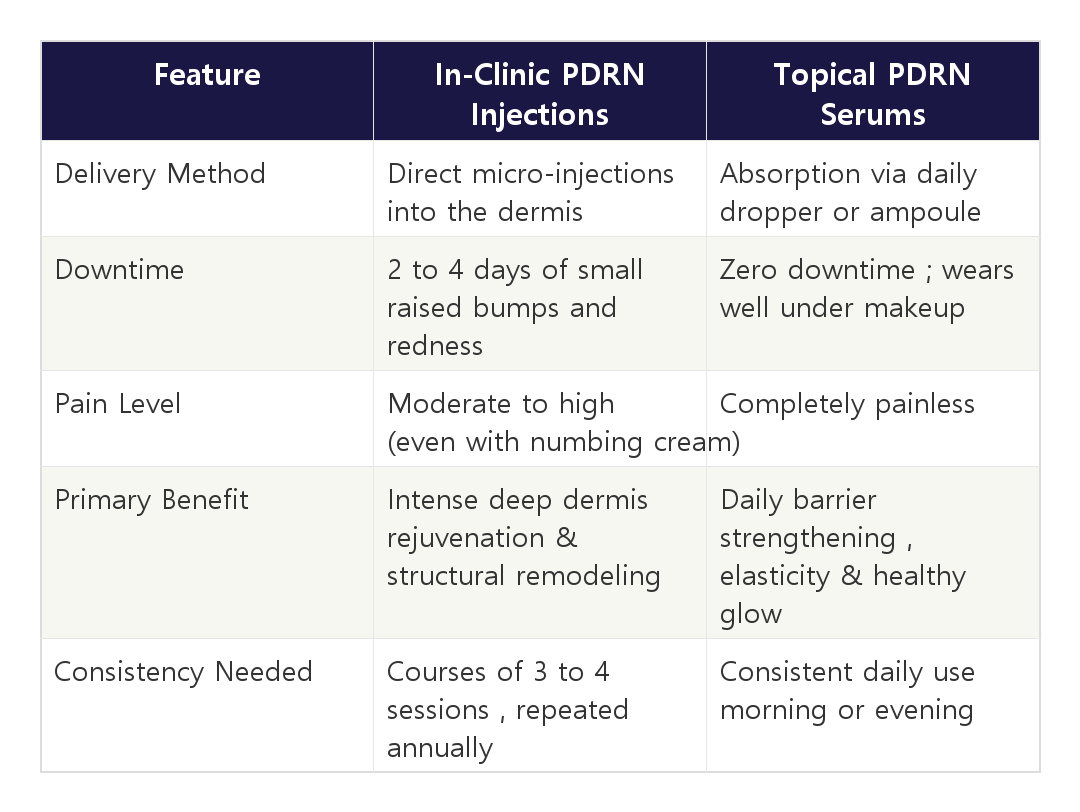
Injections vs. Topical Serums: A Clear Comparison
Before deciding whether to book a flight to Seoul or browse your favorite K-beauty shelf, take a look at how clinical treatments stack up against modern topical formulas:

How to Layer PDRN in Your Daily Routine
Because PDRN focuses on soothing and rebuilding, it plays very well with other actives in your medicine cabinet. You do not need to throw away your favorite toner or moisturizer to introduce it.
- Right After Cleansing and Toner: Apply your PDRN serum onto slightly damp, toned skin so the water-soluble nucleotides absorb smoothly.
- Pairing with Retinoids: PDRN is an exceptional buffer for prescription tretinoin or over-the-counter retinol, as its anti-inflammatory properties offset peeling and tightness.
- Pairing with Peptides & Panthenol: Stacking PDRN with soothing peptides creates an ultra-cushioning barrier cocktail for dry winter months.
- Watch the Actives: Avoid slathering high-percentage exfoliating acids (like strong AHA peels) in the exact same step, simply so your skin can focus on resting and repairing.
What to Check Before You Buy
Not all PDRN bottles are formulated equally. When checking Korean skincare labels, look for products that list sodium DNA or PDRN near the top or middle of the ingredient roster rather than as a tiny marketing trace at the very end.
For those living a vegan lifestyle or dealing with severe fish allergies, keep an eye out for “phyto-PDRN” or plant-derived DNA serums extracted from wild ginseng or marine kelp. Korean cosmetic labs recently pioneered plant-based bio-mimics that offer comparable soothing benefits without any marine animal sourcing.
Give any new bottle at least four to six weeks of steady use before judging the outcome. Cellular turnover takes roughly a month, and the real magic of PDRN shows up when you suddenly notice your skin handles dry office air and late-night exhaustion without peeling or looking washed out.
FAQ
Q. Does PDRN serum smell like fish?
A. Not at all! The DNA fragments undergo extensive medical-grade purification and filtration, leaving behind zero fishy odor or marine residue. Most formulas smell completely neutral or lightly botanical.
Q. Can sensitive or acne-prone skin use salmon DNA serums?
A. Yes, and it is often recommended for sensitized skin because PDRN originally served as an anti-inflammatory burn and wound treatment. Just make sure the overall formula is fragrance-free and non-comedogenic.
Q. How soon will I see visible changes?
A. While you will feel immediate hydration and bounce on day one, visible improvements in barrier strength, calmness, and skin elasticity typically take around 4 weeks of consistent application.
Q. Is PDRN safe to use during the daytime?
A. Absolutely. Unlike exfoliating acids or retinol, PDRN does not increase photosensitivity to sunlight. Just finish with your usual broad-spectrum sunscreen before heading out. PDRN is a tissue-repairing DNA molecule originally celebrated in Korean dermatology clinics for post-procedure healing. Modern topical serums offer accessible, painless skin barrier support, elasticity gains, and soothing properties with zero downtime. Pair PDRN serums with hydrating toners, gentle barrier creams, or night retinoids for a bouncy, long-term healthy glow.
Where to buy — Sister Unice’s picks
Disclosure: Some links below are affiliate links. If you book or buy through them, I may earn a small commission at no extra cost to you. I only recommend what I’d use myself. As an Amazon Associate I earn from qualifying purchases.
The exact items I’d point a friend to, with the link to buy:
- Medicube PDRN Pink Peptide Serum — A viral K-beauty bestseller rated 4.7/5 that pairs 1% salmon PDRN with a five-peptide complex to target fine lines and uneven tone.
- REJURAN Healer Dual Effect Ampoule — Created directly by PharmaResearch—the biopharma pioneer behind in-clinic salmon DNA injections—this 4.8/5-rated ampoule packs 5,000 ppm patented c-PDRN to jumpstart skin turnover.
- Anua PDRN Hyaluronic Acid Capsule 100 Serum — Averaging 4.8/5 stars across customer reviews, this formula encapsulates salmon PDRN alongside hydrolyzed collagen and 11 hyaluronic acid weights for bouncy glass skin.
Links go to third-party booking/shopping sites. I only list places and products with genuinely strong reviews.
If you want the authentic salon treatment experience at home, nothing beats the proprietary c-PDRN formula engineered by the very pharmaceutical laboratory that created Korea’s original Rejuran skin-booster injectable.
Not a paid placement or affiliate link — just a resource Unice trusts.
Sources
- National Center for Biotechnology Information (NCBI) — Clinical studies on polydeoxyribonucleotide (PDRN) in tissue repair and dermatology.
- KoreaMed — Academic literature on aesthetic dermatology and polydeoxyribonucleotide applications.
- Ministry of Food and Drug Safety (Korea) — Regulatory guidelines on cosmetic functional ingredients and biopolymer safety standards.
Leave a Reply