
Topical exosomes and growth factors can support skin barrier repair and post-procedure recovery, but they will not rebuild your dermal collagen overnight from a daily serum. While the laboratory science behind cellular signaling is genuine, shelf stability and skin penetration remain massive technical hurdles for over-the-counter bottles. Here is what modern dermatology actually confirms, what Korean clinics do differently, and what you can safely ignore at the beauty counter.
- The Science of Cell Talk: What These Actives Actually Do
- The Penetration Problem Bottled Cosmetics Do Not Mention
- Plant Exosomes vs. Human Stem Cell Extracts
- Realistic Results: Clinic Procedures vs. Daily Bottled Skincare
- 3 Red Flags to Watch for on Product Labels
- How to Actually Use Growth Factor Formulas at Home
- FAQ
- Summary
- Where to buy — Sister Unice’s picks
- Sources
The Science of Cell Talk: What These Actives Actually Do
Growth factors are large proteins that act like chemical couriers, telling your skin cells to produce collagen, elastin, and blood vessels. Epidermal Growth Factor (EGF) won a Nobel Prize in medicine decades ago for its role in wound healing and tissue repair.
Exosomes are tiny lipid envelopes shed by cells, packed with proteins, RNA, and lipids that instruct neighboring cells how to behave. In medical dermatology, both are celebrated because they speed up healing after laser resurfacing, burns, or microneedling.
The catch lies in the skin barrier itself. Your stratum corneum is designed specifically to keep large biological molecules out, meaning a 6,000-Dalton protein like EGF cannot simply glide through intact skin on its own.
The Penetration Problem Bottled Cosmetics Do Not Mention
Most commercial creams boast about high exosome counts, but they rarely address molecular weight or delivery pathways. An exosome ranges between 30 and 150 nanometers wide, while a healthy skin barrier typically allows absorption only of tiny molecules under 500 Daltons.
If you apply an exosome serum over unbroken, dry skin, the vast majority sits on the upper epidermal surface. It can provide hydration, antioxidant defense, and surface soothing, but it does not reprogram deep dermal fibroblasts from there.
This is why Korean dermatology clinics almost always pair exosome treatments with micro-channeling, fractional lasers, or MTS (microneedling therapy system).
Creating micro-injuries gives these delicate cellular messengers an open doorway to reach live tissue.
Plant Exosomes vs. Human Stem Cell Extracts
Turn over an everyday cosmetic box, and you will often see “Cica Exosomes” or “Lactobacillus Exosomes” listed in the ingredients. Marketers love using the word “exosome” because it sounds clinical, but plant-derived vesicles function very differently from human stem cell signals.
Plant-derived extracellular vesicles can deliver soothing plant polyphenols and antioxidants directly into the upper skin layers. They are wonderful for redness and barrier calmness, but they do not transmit human cellular rejuvenation codes.
On the other hand, genuine human adipose-derived stem cell conditioned media is strictly regulated. In standard shelf-stable cosmetics, living cells are never present, and the fragile vesicles inside an opened water-based jar break down rapidly under room temperature.
Realistic Results: Clinic Procedures vs. Daily Bottled Skincare
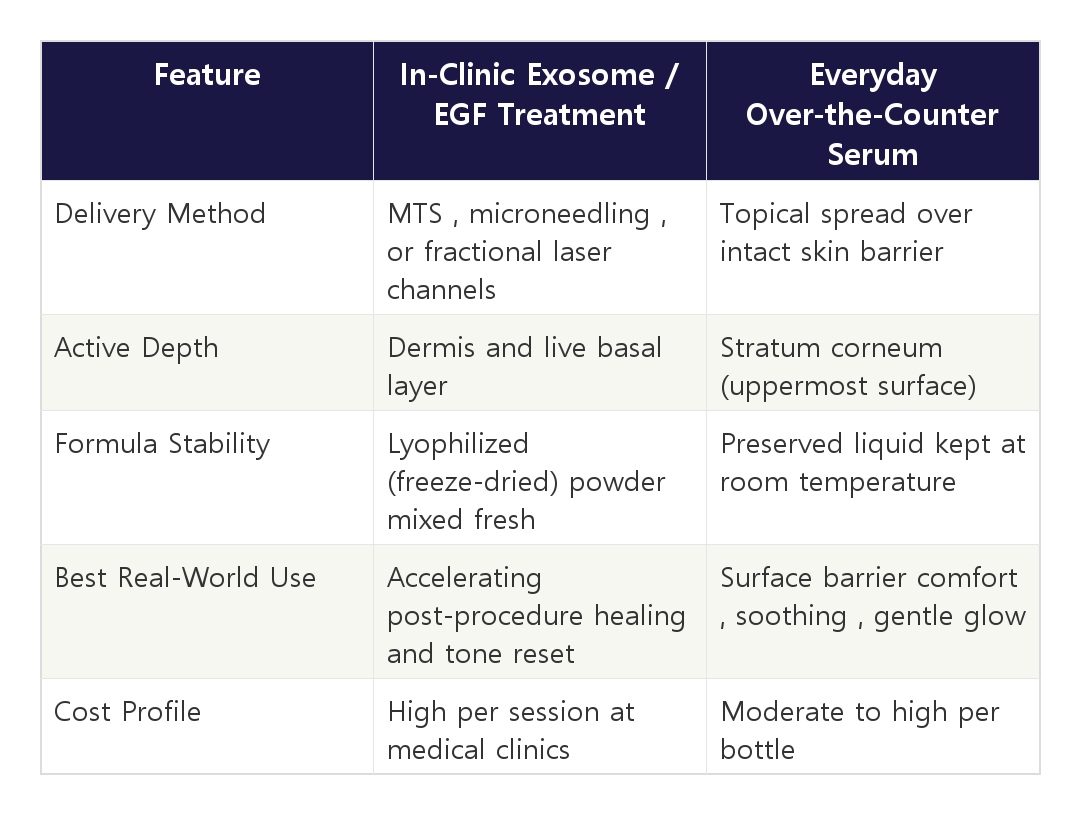
To help you decide where your skincare budget should actually go, here is an honest side-by-side comparison of clinical applications versus your bathroom vanity.
3 Red Flags to Watch for on Product Labels
Spotting marketing spin is simple once you know how regulatory cosmetic labels operate. Here are three warning signs that a product is overpromising on cellular science:
- “Stem Cells Inside” claims: Live cells cannot survive inside a commercial cosmetic bottle without life-support broth and freezing temperatures. Any product claiming “live stem cells” is factually misleading.
- Exosomes listed near the bottom: If the active extract is listed after fragrance or thickeners, the concentration is likely fractional window dressing.
- Promises of instant wrinkle erasure: Growth factors do not work like Botox; true tissue signaling takes weeks of consistent signal reception, even in medical trials.
How to Actually Use Growth Factor Formulas at Home
Does this mean daily EGF or vesicle formulas are completely useless? Not at all, provided you use them for the right biological job.
Growth factors shine brightest when your skin barrier is vulnerable or recovering. Applying an EGF formula after a mild chemical peel, or using a cushion foundation enriched with pharmaceutical-grade EGF, gives the skin a protective, replenishing environment while you wear makeup.
I use shade #21 Beige, and I am on my third compact because it glides on like a light, moisturizing essence without caking over pores.
People often ask if an EGF cushion will completely eliminate deep sun spots or stubborn pigmentation. I always give the honest answer: I cannot claim it cures spots scientifically, but in my own daily use, the gentle barrier support keeps my complexion visibly even, moisturized, and calm throughout busy days.
FAQ
Q. A. No. Retinoids have decades of clear clinical evidence proving they bind to nuclear receptors in skin cells to boost turnover. Exosomes and growth factors are calming and reparative complements, not replacements for proven cell regulators. Q. Are plant exosomes just a marketing gimmick?
A. They are not a gimmick for hydration and anti-inflammatory support, but calling them “skin-regenerating exosomes” confuses consumers. They deliver botanical antioxidants, not human growth signals.
Q. Who benefits most from growth factor skincare?
A. Individuals with compromised skin barriers, post-laser sensitivity, or thin, mature skin that needs soothing support without the irritation caused by strong exfoliating acids.
Summary
- Exosomes and growth factors are remarkable healing messengers, but intact skin prevents large molecules from reaching deep dermal fibroblasts without clinical microneedling.
- Plant-derived vesicles offer soothing antioxidant benefits on the surface, while shelf-stable creams must be evaluated realistically for stability.
- Use over-the-counter EGF formulas for gentle recovery, barrier repair, and calming hydration rather than expecting miraculous surgical-level lifts.
Where to buy — Sister Unice’s picks
Disclosure: Some links below are affiliate links. If you book or buy through them, I may earn a small commission at no extra cost to you. I only recommend what I’d use myself. As an Amazon Associate I earn from qualifying purchases.
The exact items I’d point a friend to, with the link to buy:
- medicube Exosome Shot Zero 7,500 PPM Spicule Facial Serum — Boasting a 4.5/5-star rating from over 6,100 reviews, it solves topical penetration hurdles by coating marine spicules with lacto-exosomes to deliver actives directly to pore-level dermis.
- REJURAN Dual Effect Ampoule c-PDRN Face Serum — Holding a 4.5/5-star rating across 700+ reviews, this PharmaResearch formula brings clinic-level polynucleotide regenerative technology home with patented micro-fractionated marine DNA.
- APLB Collagen EGF Peptide Ampoule Serum — Rated 4.3/5 stars by everyday K-beauty users, this gentle daily ampoule combines sh-Oligopeptide-1 with centella and collagen to safely support cellular turnover on a sensible budget.
Links go to third-party booking/shopping sites. I only list places and products with genuinely strong reviews.
While many growth factor claims are marketing fluff, Daewoong Pharmaceutical’s WHO-registered DW-EGF is genuinely backed by decades of wound-healing science, giving you true regenerative potency in a daily barrier-friendly serum.
Shop this →
As an affiliate, I may earn a small commission from purchases — at no extra cost to you.
Leave a Reply