

If you are looking for a way to truly reset your mind, a templestay in Korea offers an experience that a luxury hotel simply cannot match. I remember a time when I was working in Seoul and felt completely drained by the city’s pace; I fled to a mountain temple just to hear the water in the valley. It turned out to be the most refreshing decision I ever made for my mental health.
The Temple Atmosphere
Most Korean temples are tucked deep into the mountains, surrounded by ancient pine trees and fresh air. When I stayed at a temple, the first thing I noticed was the absolute lack of city noise—no cars, no music, and no neon lights.
In the fashion industry in Manhattan, I got used to the constant hum of the Garment District, but the silence of a temple is a different kind of power. You swap the smell of coffee and exhaust for the scent of woodsmoke and incense.
- The air in the mountains is noticeably crisper than in Seoul or Busan.
- Temples are often located near streams, providing a natural soundtrack for sleep.
- There are no “nightlife” distractions nearby, which helps your brain finally turn off.
What do you actually do all day?
A templestay is not just sitting still; it follows a specific rhythm called “Yebul” (ceremonial service).
You can choose between a “Relaxation” program or an “Experience” program depending on how much structure you want.
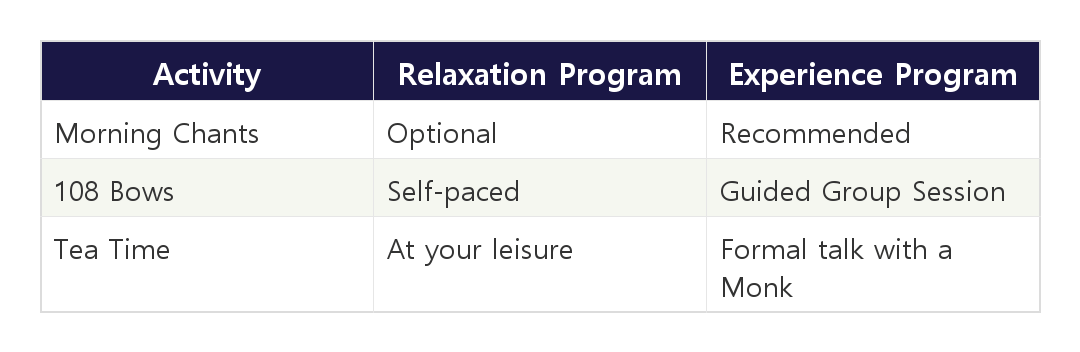
Food that heals the body
Temple food, known as Sanchae-chaek, is entirely vegan and avoids “pungent” ingredients like garlic or onions. I found the meals to be incredibly light and clean, leaving me feeling energized rather than sluggish.
During my years in New York, I often survived on cup ramen at my desk, just pouring hot water and waiting three minutes while finishing a sketch. Eating a slow, mindful meal of mountain herbs and roots at a temple felt like an apology to my body for all those rushed office lunches.

Master the art of the 108 bows
One of the most famous parts of a templestay is the 108 prostrations. It sounds like a lot of exercise, but it is actually a moving meditation designed to help you let go of your ego.
I am a Christian, so I skipped the bowing and just slipped into the hall to watch the monks chanting, purely out of curiosity. I got politely asked to step outside — which taught me faster than any guidebook that these are services, not performances for visitors. It is a physical way to clear the “clutter” from your head, much like clearing off a messy design table after a long project.
3 things to pack for your stay
While the temple provides a simple uniform (usually a vest and loose pants), you need to bring a few specific items. Trust me, you do not want to be the only person with cold feet or difficult shoes.
- Warm socks: You must take your shoes off to enter any temple hall, and the wooden floors can be very chilly.
- Slip-on shoes: You will be moving between your room and the halls constantly, so avoid anything with complicated laces.
- Layers: Even in summer, the mountain air drops in temperature significantly at night.

No religious pressure
You do not have to be Buddhist to enjoy a templestay. The programs are designed to share Korean culture and history with everyone, regardless of their background or faith.
A templestay is similar—it is an invitation to see a different way of living for 24 hours.
FAQ
Q. Do I have to speak Korean to participate?
A. Not at all! Many major temples like Jogyesa or Bongeunsa offer programs specifically for English speakers with translators available.
Q. Is it expensive to stay at a temple?
A. Most stays are very affordable, typically ranging from 50,000 to 100,000 KRW per night, which includes your room, meals, and activities.
Q. Can I use my phone during the stay?
A. You are usually allowed to keep it, but you are strongly encouraged to put it on silent and use it as little as possible to respect the environment. Templestays provide a much-needed break from the digital world and city stress. The experience focuses on mindfulness, clean vegan eating, and mountain nature. It is accessible to everyone, regardless of religion or Korean language ability.
Where to book — Sister Unice’s picks
Real, well-reviewed places I’d actually book, with the link to reserve:
- Templestay Official Korea Reservation Portal — Korea’s official government-backed reservation portal under the Jogye Order, connecting travelers directly to 130+ temples nationwide with transparent pricing and English-language programs [1.1.6].
- Bukchon Binkwan by Rakkojae (Seoul) — Offers a tranquil Bukchon hanok setting, traditional tea culture, and a serene garden in central Seoul.
- Rakkojae Hahoe Hanok Hotel (Andong) — Offers a calm stay with heated ondol rooms and heritage dining inside UNESCO-listed Hahoe Village.
- Nostalgia Hanok Hotel (Bukchon) — Highly rated on Booking.com for its quiet residential courtyard villas, private foot baths, and mindful architectural restoration.
Links go to third-party booking/shopping sites. I only list places and products with genuinely strong reviews.
If you are searching for genuine Buddhist silence, morning chanting (Yebul), and temple food, booking directly through the official Jogye Order portal is the only way to secure confirmed spots without third-party markups.
Not a paid placement or affiliate link — just a resource Unice trusts.