

I grew up in Seoul and spent my childhood exploring the neighborhood shops after school to see what was new.
The Korean idol system turns raw talent into global superstars through a structured pipeline of auditions, multi-year training, and carefully produced debuts.
Korean entertainment agencies invest heavily in voice lessons, choreography, foreign languages, and media management long before an artist ever sets foot on stage.
While the schedule is demanding, this disciplined approach is the true engine behind K-pop’s flawless live performances and global success.
How Do Agencies Spot Future K-Pop Stars?
Entertainment companies discover potential idols through global open auditions, street scouting, and private performance academies.
Agencies prioritize raw charm, rhythm, and coachability over finished technical skill.
- Global auditions take place annually across Asia, North America, and Europe.
- Scouts frequently contact promising teenagers at dance academies or outside middle schools in South Korea.
- Auditioning candidates demonstrate singing, dancing, rapping, or visual presence.
What Is Daily Life Like for a K-Pop Trainee?
A trainee’s daily schedule mirrors a high-intensity specialty boarding school that extends late into the night.
I recall working through late-night fitting sessions in the Manhattan Garment District during my fashion career. I often ate cup ramen during those late nights because it only required pouring hot water and waiting three minutes.
Most young trainees attend regular school classes in the morning before reporting directly to agency practice rooms.
A typical daily training program includes:
- Vocal and rap coaching tailored to an individual’s vocal range.
- Choreography practice focused on synchronized group timing.
- Foreign language lessons in English, Japanese, or Mandarin.
- Media etiquette, public speaking, and posture training.
How Long Does the Trainee Period Last?
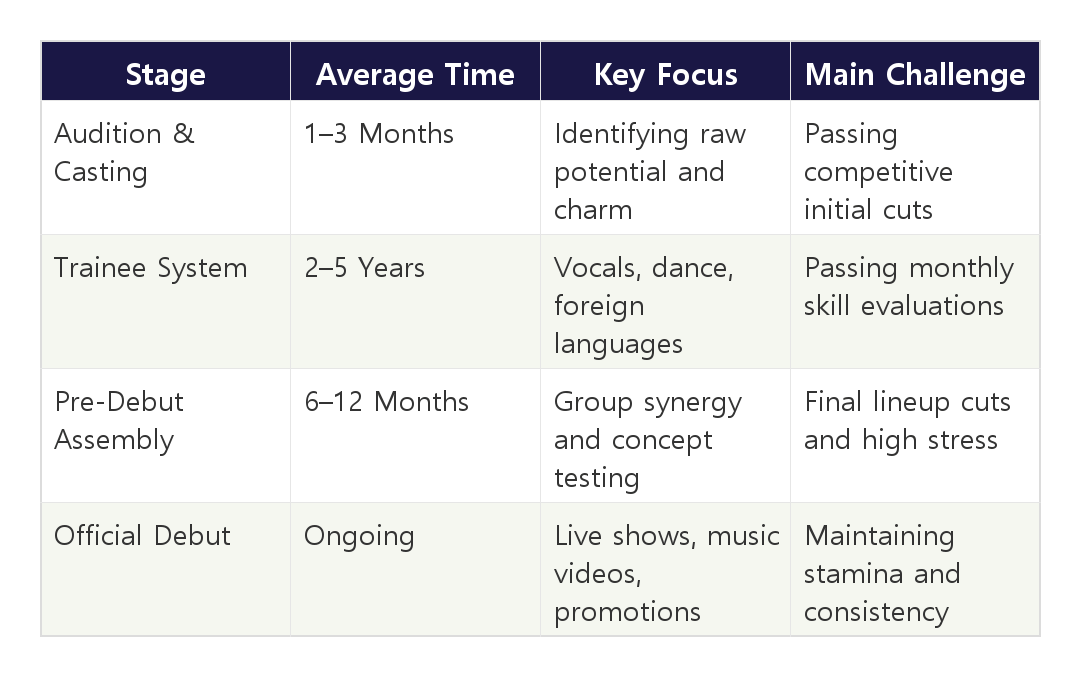
The average training period lasts between two to five years, though some idols train for months while others train for nearly a decade.
Monthly evaluation tests determine whether a trainee advances, remains in the program, or gets released.
These regular assessments teach young performers how to handle pressure and continuous feedback.
Because agencies cover lesson and living expenses upfront, monthly reviews are strict and competitive.

How Are K-Pop Groups Formed and Debuted?
Agencies do not simply group the top overall performers; they build balanced teams where individual member strengths complete one another.
Each group member receives designated roles, such as main vocalist, main dancer, leader, or visual representative.
Once a team is selected, the pre-debut phase focuses on recording tracks, filming music videos, and building initial fan awareness.
How Has the Idol System Changed Recently?
Modern agencies place greater emphasis on mental wellness support, education, and long-term artistic independence than in past decades.
I once went on a temple stay in the mountains because I felt mentally exhausted from work and needed to refresh my mind. Staying in a quiet place with clean air away from the city helped me recover and recharge.
Trainees now receive professional mental health counseling alongside songwriting, composing, and music production classes.
Reality audition shows have also made the process transparent, allowing international fans to support trainees before their official launch.

FAQ
Q. Do trainees have to pay for their training lessons?
A. Major K-pop agencies cover housing, food, and lesson costs during the training period. In the modern industry, top labels treat these expenses as company investments rather than personal debt for the artists.
Q. Can non-Korean citizens become K-pop idols?
A. Yes, agencies regularly hold global auditions and debut non-Korean members from countries like Japan, Thailand, China, Canada, and the United States.
Q. What happens to trainees who do not make the final group?
A. Trainees who leave an agency often transfer to another company, pivot to acting or modeling, or return to regular academic studies. The Korean idol system relies on structured talent identification, rigorous skill building, and teamwork. Trainees spend years mastering vocal precision, synchronized dancing, and international communication skills. Today’s training programs increasingly prioritize artistic growth, wellness, and direct engagement with global audiences.
Where to book — Sister Unice’s picks
Real, well-reviewed places I’d actually book, with the link to reserve:
- Pop Star Academy: KATSEYE — This official Netflix docuseries offers an inside look at HYBE and Geffen’s intense global K-pop audition and trainee system.
- 1MILLION ViBE K-Pop Dance Experience in Seoul — This experience lets fans train in the Seoul studio where choreography for K-pop idols is created.
- Authentic K-Pop Recording Experience at KING STUDIO — This package lets you record a song in a professional Seoul studio with active K-pop sound producers.
Links go to third-party booking/shopping sites. I only list places and products with genuinely strong reviews.
Unice highly recommends this docuseries for an eye-opening, raw look into how modern K-pop idols are trained and evaluated.
As an affiliate, I may earn a small commission from purchases — at no extra cost to you.
Sources
Korea.net — Official Korean Culture and Information Service
Yonhap News Agency — Korean Entertainment & Culture News
Billboard — Global K-Pop Industry Coverage