
If your skin feels tight and irritated despite layering five hydrating products, your moisture barrier is waving a white flag. Hyaluronic acid gets all the marketing glory, but beta-glucan is the quiet workhorse Korean cosmetic chemists actually rely on to heal compromised skin. It holds roughly 20 percent more moisture than hyaluronic acid and actively accelerates skin repair without causing stickiness or clogged pores.
Why Hyaluronic Acid Keeps Letting You Down
Hyaluronic acid is a humectant, meaning it grabs water like a sponge and pulls it toward the surface of your skin. That works beautifully in a humid bathroom or a tropical climate.
When the air around you is bone-dry, hyaluronic acid cannot find atmospheric water. Instead, it pulls moisture from the deeper layers of your own skin, evaporating into thin air and leaving your barrier parched.
If you have ever felt a tight, papery sensation thirty minutes after applying a pure hyaluronic acid serum, that reverse dehydration is exactly what happened.
How Beta-Glucan Actually Repairs the Skin Barrier
Beta-glucan is a natural polysaccharide derived from oats, baker’s yeast, or split-gill mushrooms (known in skincare as Schizophyllum commune). Rather than sitting passively on your epidermis, it works as a biological response modifier.
Because of its molecular structure, beta-glucan passes deeply through the intercellular space between epidermal cells. Once inside, it stimulates macrophage activity, which prompts your skin to produce new collagen and calm acute inflammation.
- Deep hydration: It locks water molecules into the stratum corneum with greater tensile strength than standard polysaccharides.
- Redness relief: It suppresses pro-inflammatory cytokines, making it ideal for flare-ups from retinol, chemical peels, or windburn.
- Antioxidant defense: It helps shield cellular DNA from ambient environmental stress and oxidative damage.
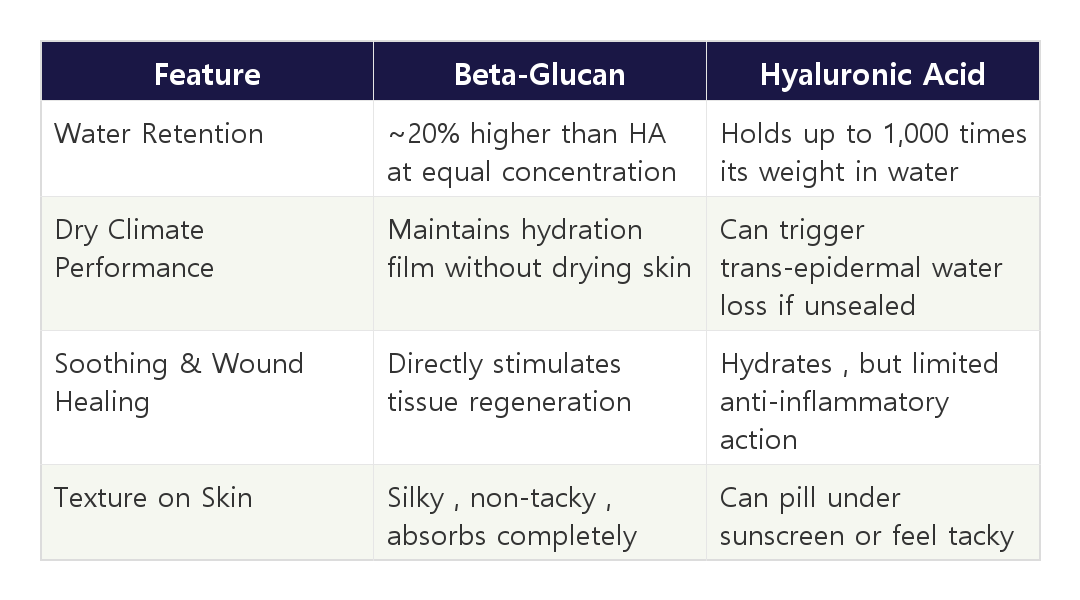
Beta-Glucan vs. Hyaluronic Acid: Head-to-Head
Both ingredients belong in the hydration family, but their biological performance and texture serve very different skin states. Here is how they stack up side by side.
Read the Ingredient Label Like a Seoul Chemist
Walk through an Olive Young flagship in Myeongdong and you will rarely see huge billboards screaming “BETA-GLUCAN!” It does not have the flash of snail mucin or retinal.
Instead, Korean dermatologists quietly formulated it into clinical barrier lines. Brands like iUNIK proved that a minimal, 100% beta-glucan liquid could outsell luxury recovery ampoules purely through word-of-mouth among sensitive skin communities.
When scanning an ingredient list (INCI), look for Beta-Glucan directly in the top five ingredients, or search for Schizophyllan, which designates the fermented mushroom extract favored for medical-grade soothing.
Who Should Swap Their Routine Right Now?
Do you actually need to ditch your current hydrator for this ingredient? Not necessarily, unless your skin matches one of three clear profiles.
First, anyone using prescription retinoids or frequent AHA/BHA exfoliation should make the switch immediately. Beta-glucan cushions the harsh micro-peeling of chemical actives without suffocating congested pores.
Second, people with fungal acne or seborrheic dermatitis often find traditional rich creams trigger breakouts. A pure fungal- or yeast-derived beta-glucan serum provides plumping moisture without feeding malassezia yeast.
Finally, if you live somewhere with freezing winter heating or dry desert heat, beta-glucan will protect your skin barrier without demanding the thick layer of petroleum jelly that ruin your pillowcases.
FAQ
Q. Can I use beta-glucan alongside Vitamin C and retinol?
A. Yes, beautifully. Beta-glucan has no known negative interactions with active ingredients; in fact, pairing it under retinol or L-ascorbic acid significantly reduces the stinging and flaking those actives commonly trigger.
Q. Is beta-glucan safe for oily, acne-prone skin?
A. It is one of the safest hydrators available for blemish-prone complexions. It has a zero rating on the comedogenic scale, absorbs without leaving a greasy sheen, and supports the skin’s innate immune defense against acne bacteria.
Q. How long does it take to see barrier repair results?
A. Most people notice immediate relief from burning or itching sensations within twenty minutes. Visible structural barrier recovery—reduced redness, smoother texture, and zero flaking—typically takes seven to ten days of consistent morning and evening use. Beta-glucan outperforms hyaluronic acid in water retention capacity by roughly 20 percent while resisting dry-climate evaporation. Its micro-pathway penetration accelerates cellular repair, making it the premier choice for compromised or over-exfoliated skin. Look for clean formulations featuring mushroom- or oat-derived beta-glucan near the top of the ingredient label.
Where to buy — Sister Unice’s picks
Disclosure: Some links below are affiliate links. If you book or buy through them, I may earn a small commission at no extra cost to you. I only recommend what I’d use myself. As an Amazon Associate I earn from qualifying purchases.
The exact items I’d point a friend to, with the link to buy:
- iUNIK Beta-Glucan Power Moisture Serum — The holy grail of Korean beta-glucan skincare, delivering 20% more moisture retention than hyaluronic acid with a clean 400,000 ppm mushroom-derived formula and over 8,000 5-star ratings worldwide.
Links go to third-party booking/shopping sites. I only list places and products with genuinely strong reviews.
Unice recommends this exact serum because its pure mushroom-derived beta-glucan delivers deep, cushiony barrier hydration without the clinginess or rebound dryness commonly experienced with classic hyaluronic acid.
As an affiliate, I may earn a small commission from purchases — at no extra cost to you.
Sources
National Center for Biotechnology Information: Anti-Wrinkle and Barrier Properties of Beta-Glucan
DermNet: Polysaccharides in Dermatology and Wound Management
Korea Science: Dermatological Efficacy of Fermented Beta-Glucan Formulations
Leave a Reply