

Growing up in Seoul, I spent my afternoons at the neighborhood supermarket looking at new snacks, but I was also constantly learning to read the quiet social signals around me.
Nunchi is the traditional Korean practice of quickly reading a room, sensing the unspoken emotional atmosphere, and adapting your behavior to maintain social harmony.
Literally translating to “eye-measure,” it allows you to understand what people are feeling and needing before they ever say a word out loud.
Developing quick nunchi can immediately improve your workplace communication, personal friendships, and overall emotional intelligence.
What Does Nunchi Actually Mean in Daily Korean Life?
At its core, nunchi (눈치) means gauging a situation using your eyes, ears, and quiet intuition.
My father taught me that when drinking with elders, I must turn my head away after a toast as a sign of respect. This was a practical lesson in adjusting my behavior based on the social context and the person in front of me.
It is the real-time evaluation of context, facial expressions, tone of voice, and body language before you decide to act or speak.
In Korean society, having good nunchi means you are perceptive and polite, while ignoring the mood around you can lead to awkward moments.
In daily life, this simple skill shows up in small, thoughtful actions.
For instance, if you notice someone’s water glass is empty at dinner, you refill it without waiting to be asked.
If a team leader looks stressed during a meeting, a person with fast nunchi will save non-urgent questions for later.
It is not about mind-reading, but about paying close attention to what is happening around you right now.
How Is Nunchi Different From Empathy or EQ?
While emotional intelligence (EQ) focuses on identifying and managing emotions, nunchi prioritizes speed, context, and situational awareness.
Empathy means feeling what another person feels, whereas nunchi is about sensing the overall balance of the entire room.
Think of emotional intelligence as understanding human feelings, while nunchi is the practical skill of navigating those feelings smoothly in real time.
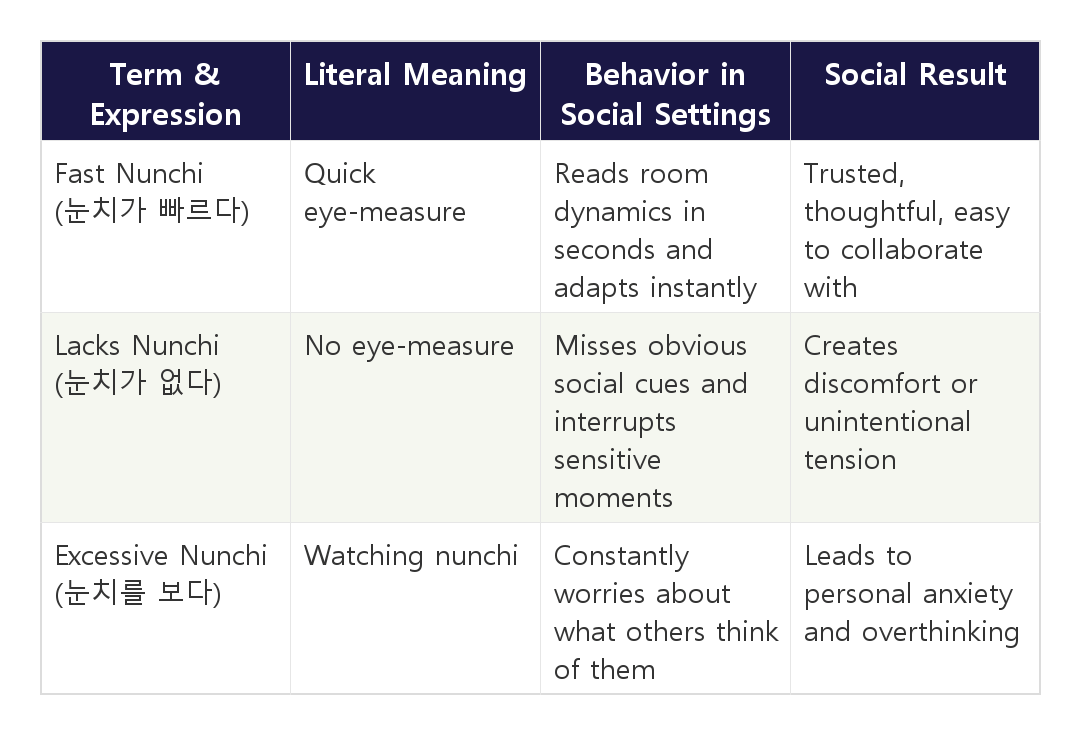
Here is how different states of nunchi compare in everyday social situations:

Why Is Nunchi So Important in Korean Culture?
Korea is historically a high-context culture where group harmony is valued above individual expression.
During Kimjang, I watched the women in my family process dozens of cabbages together in perfect, unspoken coordination. We maintained group harmony by anticipating each other’s needs without needing to speak out loud.
Because direct confrontation can cause loss of face or public discomfort, people rely on subtle signals to communicate their feelings and expectations.
Nunchi serves as the social glue that keeps relationships running smoothly without unnecessary arguments.
From family gatherings to corporate offices, practicing nunchi is considered a basic sign of respect and maturity.
It helps people honor social hierarchy, show hospitality to guests, and support team goals without needing constant verbal instructions.
How Can You Practice Fast Nunchi Every Day?
Developing fast nunchi is not an innate talent, but a conscious habit that anyone can build over time.
In my work running an assisted living home, I notice that families often ask about prices but miss the subtle details of daily life and food quality. I’ve realized that observing these quiet, overlooked elements is the best way to truly understand the energy of a new environment.
By shifting your focus outward and observing people around you, you can improve your social timing significantly. Here are four simple ways to start practicing today:
- Enter a room quietly and observe: Take ten seconds to scan the room’s energy before speaking or jumping into a conversation.
- Watch body language first: Look at posture, eye contact, and facial movements rather than listening only to spoken words.
- Put away digital distractions: Turn off your phone during group meals or meetings so you remain fully aware of the social environment.
- Prioritize the collective atmosphere: Ask yourself what the room needs right now—whether that is quiet support, humor, or a gentle change of subject.

FAQ
Q. Is nunchi the same as social anxiety?
A. No, true nunchi is grounded in calm observation and outward awareness, whereas social anxiety comes from inward fear and self-consciousness. While anxiety makes you worry about how others view you, good nunchi helps you focus clearly on what others need.
Q. What does “nunchi-ga eopsda” mean?
A. It literally translates to “having no nunchi.” It describes someone who is oblivious to social cues, speaks at inappropriate moments, or fails to notice when people around them are uncomfortable.
Q. Can nunchi help in Western workplaces?
A. Absolutely. Even in cultures that prefer direct feedback, being able to read room dynamics, time your proposals well, and spot team fatigue early gives you a strong professional advantage.
Q. Is there a popular book about this concept?
A. Yes, author Euny Hong wrote a widely acclaimed book titled The Power of Nunchi: The Korean Secret to Happiness and Success , which brought the concept into mainstream global discussions. Nunchi is the Korean practice of reading context, body language, and room dynamics to navigate social situations gracefully. Unlike standard emotional intelligence, nunchi emphasizes quick observation and preserving group harmony in real time. Anyone can develop fast nunchi by listening carefully, observing before speaking, and focusing on the people around them.
Where to buy — Sister Unice’s picks
The exact items I’d point a friend to, with the link to buy:
- The Power of Nunchi by Euny Hong — Authored by Euny Hong, this globally acclaimed guide boasts thousands of 4+ star ratings for breaking down Korea’s room-reading superpower into practical everyday habits.
- Traditional Korean Tea Ceremony & Meditation Experience in Seoul — This peaceful hanok workshop teaches nonverbal mindfulness and social etiquette through traditional tea rituals.
- TEUIDA: Spoken Korean & Social Scenarios App — TEUIDA uses first-person interactive videos to practice context-sensitive social interactions in real time.
- Talk To Me In Korean (TTMIK) Cultural & Language Platform — Trusted by more than 1 million learners worldwide, TTMIK offers structured online courses that illuminate situational honorifics and subtle Korean social dynamics.
Links go to third-party booking/shopping sites. I only list places and products with genuinely strong reviews.
The definitive book on nunchi by Euny Hong — a clear, readable deep dive into the concept.
As an affiliate, I may earn a small commission from purchases — at no extra cost to you.
Sources
BBC Worklife: Nunchi, the Korean perceptual art of ‘eye-measure’
The New York Times: Nunchi, the Korean Art of Emotional Intelligence
The Guardian: Nunchi, the Korean secret to happiness and success