

A true barrier cream does not just sit on top of your face like grease; it actively replaces the lost lipids your skin uses to defend itself. When your skin feels tight, looks red, or stings from gentle tap water, your moisture barrier is cracked. The solution is not piling on thicker oils, but feeding your outer layer the exact ratio of ceramides, cholesterol, and fatty acids it lost.
- The Brick-and-Mortar Reality of Your Stratum Corneum
- Manhattan Fittings and the Dry-Skin Panic
- Is Your Skin Barrier Actually Damaged?
- The Golden Lipid Ratio That Truly Works
- Top Korean Barrier Creams Compared
- Three Critical Habits While Your Skin Heals
- FAQ
- Where to buy — Sister Unice’s picks
- Sources
The Brick-and-Mortar Reality of Your Stratum Corneum
Dermatologists often describe your outermost skin layer like a sturdy brick wall. Your skin cells are the bricks, and the natural lipids between them are the mortar holding everything together.
When that mortar dries up or washes away, invisible cracks open across the surface. Moisture escapes instantly, and outside irritants slip straight in.
That is why regular hydrators often fail when your skin is irritated. Hyaluronic acid pulls water in, but without strong lipid mortar to seal the surface, that water evaporates right into thin air.
Manhattan Fittings and the Dry-Skin Panic
Back when I worked as a fashion designer in Manhattan’s Garment District, runway prep meant endless late-night fittings.
Models would sit in the fitting room with raw, flaky cheeks while makeup artists desperately tried to smooth on foundation. Layering heavy cold creams never worked; it just created a slick film over peeling skin.
We learned quickly that soothing irritated skin requires replenishing physiological lipids, not just slathering on heavy butter.
Is Your Skin Barrier Actually Damaged?
A compromised barrier gives very clear warning signs before it turns into full-blown dermatitis. The trouble is that many people mistake these signs for sudden breakouts or sudden dryness.
- The sting test: Your everyday, mild cleanser or plain moisturizer suddenly stings or burns upon application.
- The tight shine: Your skin looks shiny, almost like plastic wrap, but feels uncomfortably tight underneath.
- Rough patchiness: Foundation clings to uneven flakes, even after you tried using gentle exfoliation.
- Sudden flushing: Walking from cold air into a warm room makes your cheeks burn bright red and itch.
If you checked two or more of those boxes, put down all exfoliating acids and retinoids immediately. Your barrier is calling for emergency repair.

The Golden Lipid Ratio That Truly Works
Not every rich moisturizer qualifies as a true barrier treatment. To rebuild the intercellular matrix, the formula needs ingredients that mimic your skin’s natural composition.
The gold standard combination contains three essential components: ceramides, cholesterol, and free fatty acids. Research shows that combining these three in balanced proportions accelerates recovery far quicker than ceramides alone.
Look also for panthenol (provitamin B5) and madecassoside on the ingredient list. Panthenol pulls in hydration while reinforcing tissue structure, and madecassoside calms down underlying inflammatory signals.
Top Korean Barrier Creams Compared
Korean cosmetic labs have spent decades perfecting physiological lipid delivery. On our vanity table at home, a tube of Aestura Atobarrier 365 Cream has a permanent spot because it simply gets the job done without fuss.
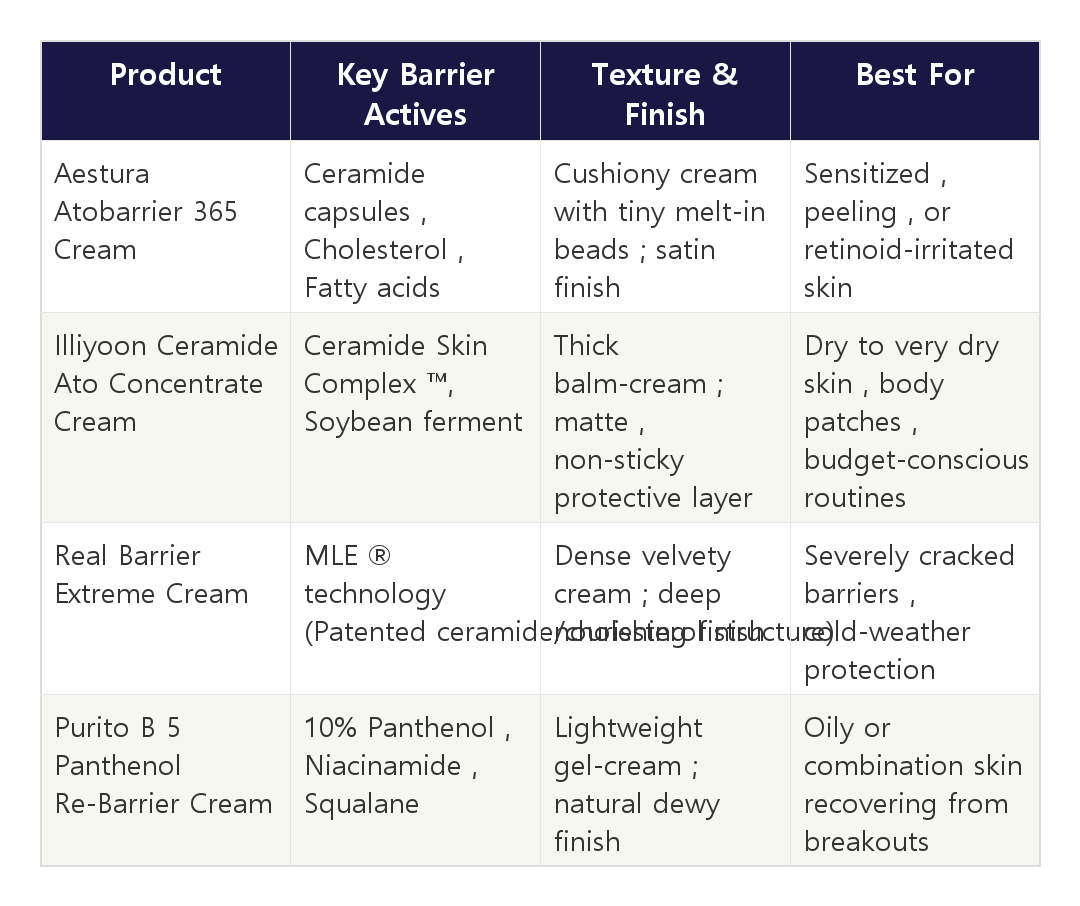
If you prefer a lightweight feel, look for formulas that feature panthenol and squalane instead of heavy waxes. Those with severe flaking will do better with encapsulated ceramide formulas like Aestura or MLE-structured balms like Real Barrier.

Three Critical Habits While Your Skin Heals
Applying a barrier cream is only half the battle. You also have to stop doing the little daily things that dismantle your stratum corneum in the first place.
- Wash with lukewarm water only: Hot water dissolves the natural protective sebum on your face faster than harsh soap. Keep shower water away from your face.
- Pause all chemical and physical exfoliants: Put your AHA, BHA, and vitamin C serums in a drawer for at least two weeks. Your skin cannot rebuild while being dissolved.
- Skip the morning foaming cleanser: Rinse with plain water in the morning to preserve the lipids your skin synthesized overnight.
FAQ
Q. Can a barrier cream cause acne if I have oily skin?
A. It can if it relies heavily on pore-clogging waxes or mineral oil. Choose barrier creams specifically formulated for oily types, using light squalane, ceramides, and panthenol instead of heavy occlusives.
Q. How many days does it take to repair a damaged skin barrier?
A. Mild irritation usually calms down within 3 to 7 days of consistent care. A deeply compromised barrier from over-exfoliation or aggressive treatments generally takes a full skin cycle of 2 to 4 weeks to completely regenerate.
Q. Is slugging with pure petrolatum the same as using a barrier cream?
A. No. Petrolatum creates an impenetrable moisture seal, but it does not supply the missing lipids. A barrier cream provides the physiological building blocks (ceramides and fatty acids) that your skin integrates into its cellular structure.
Q. Should I apply barrier cream in the morning before sunscreen?
A. Yes, especially if your skin feels tight or the weather outside is dry and windy. Let the cream absorb for two minutes so it creates an even base before tapping on your sunscreen. Your skin barrier requires balanced physiological lipids (ceramides, cholesterol, fatty acids), not just heavy occlusive greases. Tingle sensations, unexpected redness, and tight-looking skin are clear signs to stop all exfoliants immediately. Consistent repair routines restore the outer protective shield within one to three weeks.
Where to buy — Sister Unice’s picks
Disclosure: Some links below are affiliate links. If you book or buy through them, I may earn a small commission at no extra cost to you. I only recommend what I’d use myself. As an Amazon Associate I earn from qualifying purchases.
The exact items I’d point a friend to, with the link to buy:
- AESTURA ATOBARRIER365 Cream (80ml) — Holds a 4.6-star rating from over 4,000 reviews, beloved for patented micro-ceramide capsules that deliver clinically tested 120-hour barrier restoration.
- ILLIYOON Ceramide Ato Concentrate Cream (200ml) — Korea’s top-selling value barrier moisturizer with thousands of 5-star ratings, using patented ceramide capsules that safely soothe eczema-prone skin.
- ETUDE SoonJung 2x Barrier Intensive Cream (60ml) — Maintains a 4.5-star rating across more than 10,000 user reviews thanks to a minimalist 21-ingredient Panthensoside formula designed for damaged, stinging skin.
- PURITO SEOUL B5 Panthenol Re-Barrier Cream (80ml) — Rated 4.7 stars for pairing 10% panthenol with cica and squalane to rebuild fragile skin without clogging pores or feeling greasy.
Links go to third-party booking/shopping sites. I only list places and products with genuinely strong reviews.
This dermatologist-developed Korean cult favorite uses encapsulated ceramides and fatty acids that melt right into stripped skin to lock in deep, lasting moisture.
As an affiliate, I may earn a small commission from purchases — at no extra cost to you.
Leave a Reply