

If you wear daily sunscreen, tinted moisturizer, or long-wear makeup, a cleansing balm breaks down stubborn oil and pigment far better than micellar water. Micellar water is brilliant for quick morning touch-ups or late nights when you simply cannot face the sink, but in true Korean skincare, it rarely replaces a dedicated oil cleanser.
Double cleansing does not need to feel like an exhausting ten-step chore. Once you understand how these two first-cleansers work, picking the right one takes about thirty seconds.
- The Real Logic Behind the Korean Double Cleanse
- Cleansing Balm: Why Melting Beats Rubbing Every Time
- Where Micellar Water Shines (and the Hidden Cotton Pad Catch)
- Head-to-Head: Balm vs Micellar Water
- Which One Fits Your Daily Skin Routine?
- Three Emulsifying Mistakes You Might Be Making
- FAQ
- Summary
- Where to buy — Sister Unice’s picks
- Sources
The Real Logic Behind the Korean Double Cleanse
The principle is simple chemistry: like dissolves like. Daily sebum, silicone primers, waterproof mascara, and modern chemical sunscreens are oil-based, meaning water alone simply slides over them.
A first cleanser grabs those oily residues without disturbing your skin barrier. Your regular water-based foam or gel cleanser then sweeps away sweat, dust, and any remaining traces.
You are not washing your face twice to make it squeaky clean; you are washing it gently so your barrier stays calm.
Cleansing Balm: Why Melting Beats Rubbing Every Time
Cleansing balms start as a soft sherbet solid and melt into a silky oil upon contact with body heat. They contain emulsifiers, meaning they turn into a milky fluid the second you splash warm water onto your face.
Because you work a balm in with your clean fingers, there is zero friction from cotton pads. That gliding texture creates a buffer, protecting delicate capillaries around your eyes and nose.
- Melts waterproof formulas: Dissolves stubborn mascara and mineral sunscreen without tugging.
- Travel-safe convenience: Solid formulas will not leak across your suitcase or carry-on tote.
- Gentle pore decongestion: Spending sixty seconds massaging your T-zone helps loosen stubborn sebum plugs.
If your skin leans dry, dehydrated, or mature, a cleansing balm is usually your best friend. It leaves behind clean, supple skin rather than a parched, stripped feeling.
Where Micellar Water Shines (and the Hidden Cotton Pad Catch)
Micellar water uses tiny clusters of cleansing molecules (micelles) suspended in soft water to attract dirt like tiny magnets. It feels light, looks like toner, and requires zero sink rinsing in a pinch.
It is the undisputed champion for lazy evenings, festival camping, gym bags, and fixing eyeliner smudges with a cotton swab. Sensitive complexions that react to botanical oils often tolerate fragrance-free micellar waters very comfortably.
Here is the catch most beauty tutorials forget to mention: the cotton pad does the actual work. Dragging woven cotton across dry, sensitive cheeks every single night creates mechanical friction.
If you use micellar water, soak the cotton pad completely until it is dripping wet. Press it gently against your skin for ten seconds to let the micelles dissolve the pigment, then wipe once without scrubbing back and forth.

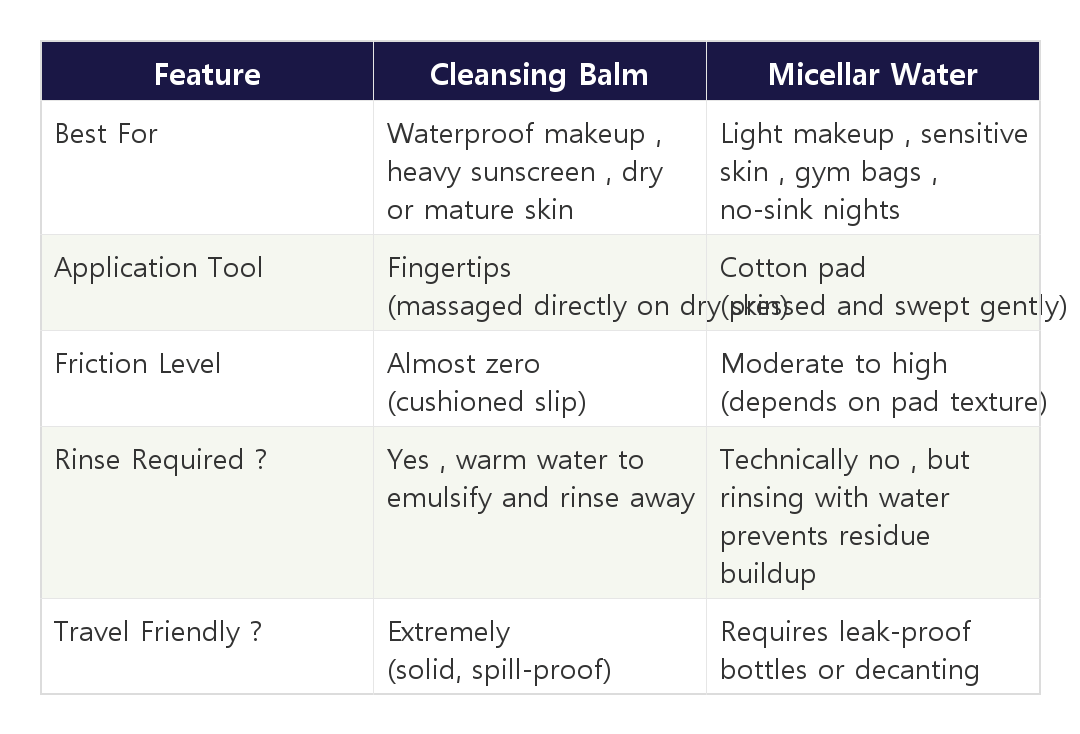
Head-to-Head: Balm vs Micellar Water
Still debating which one belongs on your bathroom counter? Here is how they stack up side by side:
Which One Fits Your Daily Skin Routine?
You do not need to pledge absolute loyalty to just one. Many Seoul dermatologists recommend keeping both on your vanity and rotating them depending on your day.
Reach for a cleansing balm when you have spent the day in full foundation, reapplied SPF several times, or feel your skin drying out from indoor heaters and air conditioners. It acts almost like an evening ritual, forcing you to slow down and massage your face.
Reach for micellar water on makeup-free days when you only wore a light moisturizer, right after an afternoon workout, or when you are simply too exhausted to splash water around your bathroom sink. Just follow up with a quick splash of tepid water whenever possible to keep surfactant residue from lingering on your pores.

Three Emulsifying Mistakes You Might Be Making
If cleansing balms ever gave you small whiteheads or left a blurry film over your eyes, you probably skipped the most crucial step: proper emulsification. Here are three quick adjustments that change everything:
- Always start with bone-dry hands and a dry face: If your hands are wet when you scoop the balm, the formula breaks down before it can bond with the oils on your skin.
- Do not rinse immediately: After massaging the balm, wet your fingertips with warm water and massage your face again. Watch it turn milky white—that is the emulsifier working.
- Keep water lukewarm: Hot water strips your natural lipid barrier, while cold water causes the balm waxes to stiffen instead of melting away cleanly.
FAQ
Q. Will a cleansing balm clog my pores if I have acne-prone skin?
A. Not if you rinse and follow with a water-based cleanser. Quality Korean balms contain emulsifiers that rinse completely clean, but look for formulas using lightweight esters or sunflower seed oil rather than mineral oil if you are prone to congestion.
Q. Do I really need to wash off micellar water?
A. Yes, dermatologists generally recommend rinsing. Leaving cleansing surfactants sitting on your face can lead to dryness and irritation over time, especially if you have sensitive skin.
Q. Can I use micellar water as my second cleanser after an oil balm?
A. It is better to use a gentle foaming or gel cleanser. Micellar water is another first cleanser; it does not replace the water-based wash that sweeps away sweat and dissolved balm traces.
Q. How much balm should I scoop out per wash?
A. A nickel-sized amount (about the size of a dime to a small cherry) is plenty for your entire face and neck. Using too much just wastes product and takes longer to rinse away.
Summary
- Use cleansing balms to melt water-resistant SPF and heavy makeup with zero cotton pad friction.
- Keep micellar water for no-sink emergencies, quick gym cleanups, and gentle morning refreshes.
- Always emulsify your balm with warm water until milky before rinsing, and follow with a mild water-based cleanser.
Where to buy — Sister Unice’s picks
The exact items I’d point a friend to, with the link to buy:
- Banila Co Clean It Zero Cleansing Balm Original — The benchmark K-beauty cleansing balm with over 100 million units sold worldwide and a 4.7+ star rating, effortlessly dissolving waterproof makeup and SPF.
- Beauty of Joseon Radiance Cleansing Balm — Averages a 4.8/5 rating across hundreds of reviews, utilizing traditional Korean rice water and fermented grains to soothe skin without stinging eyes.
- Round Lab 1025 Dokdo Cleansing Water — Rated 4.8/5 for sensitive skin, this mineral-rich Ulleungdo deep sea water formula gently lifts impurities with panthenol and triple hyaluronic acid.
Links go to third-party booking/shopping sites. I only list places and products with genuinely strong reviews.
It remains the quintessential Korean first-cleanse step because its sherbet-to-oil texture dissolves the toughest sunscreen and makeup effortlessly without leaving a greasy film.
Not a paid placement or affiliate link — just a resource Unice trusts.
Sources
- American Academy of Dermatology — Guidelines on gentle facial cleansing and barrier care
- Korean Ophthalmological Society — Insights on eye-area friction and safe makeup removal
- U.S. Food and Drug Administration — Information on cosmetic surfactants and micellar ingredients
Leave a Reply