

Growing up in Seoul, I loved stopping at the neighborhood supermarket to see the newest products — and in Korea, daily sun protection is treated as casually as brushing your teeth.
Korean sunscreens have taken over bathroom counters across the United States because they feel like an airy moisturizer rather than a thick, chalky pool lotion. Modern Korean formulas feel completely different, and there is clear cosmetic science behind why Western sunscreens feel so far behind.
The secret lies in newer UV filters, gentle skincare bases, and an entirely different cultural philosophy around sun protection. Once you try a formula that sinks into your skin in ten seconds without stinging your eyes, it is almost impossible to go back.
- The Regulatory Reason Western Sunscreens Feel So Heavy
- Why Modern Korean Sunscreens Absorb Like a Serum
- Do Korean Sunscreens Hold Up Under Daily Makeup?
- Western Sunscreen vs. Korean Daily SPF: At a Glance
- Cult-Favorite Bottles Making the Biggest Waves
- 3 Practical Rules Before You Order
- FAQ
- Summary
- Where to buy — Sister Unice’s picks
- Sources
The Regulatory Reason Western Sunscreens Feel So Heavy
Every single bottle relied on the exact same short list of active ingredients, mostly avobenzone, oxybenzone, and zinc oxide.
Korean shoppers are used to a far wider range of lightweight formulas than the typical US drugstore aisle offers.
In the United States, the Food and Drug Administration (FDA) classifies sunscreens as over-the-counter drugs. Because of that designation, approving a new UV filter requires years of extensive clinical trials that mirror the approval process of pharmaceutical medications.
South Korea’s Ministry of Food and Drug Safety, along with regulatory bodies in Europe and Japan, classifies sunscreens as functional cosmetics. This regulatory structure has allowed Korean cosmetic chemists to utilize advanced chemical filters like Uvinul A Plus, Tinosorb S, and Mexoryl SX for over a decade.
These newer filters are significantly more photostable than older American chemicals, meaning they do not break down as rapidly when exposed to direct daylight. More importantly, they require far lower oil concentrations to stabilize, which helps avoid that greasy, suffocating film most of us grew up dreading.
Why Modern Korean Sunscreens Absorb Like a Serum
Traditional American sunscreens were created primarily for swimming and outdoor sports, where a waterproof, clingy barrier is an asset. Korean sunscreens, by contrast, were designed from the beginning as the final step of everyday morning skincare.
Instead of relying on heavy mineral oils or thick silicone polymers, Korean cosmetic labs formulate sunscreens with high percentages of hydrating skincare ingredients. You will regularly spot fermented rice filtrate, birch juice, heartleaf, and centella asiatica (cica) near the top of the ingredient list.
This means your morning SPF functions as a calming day cream, antioxidant booster, and UV shield in a single squeeze. You do not need to wait ten minutes for a sticky residue to dry down before stepping out the door.
Do Korean Sunscreens Hold Up Under Daily Makeup?
If your base product balls up or slips around, no designer foundation can save the look.
White residue is the classic sign of a base that isn’t absorbing properly — and under bright lights it shows up fast. Even the best foundation can’t fix the look if the sun protection underneath is too heavy.
Korean sunscreens act as exceptional makeup primers because they absorb cleanly into the stratum corneum rather than sitting on top as a greasy seal. They leave skin plump and hydrated, which prevents foundation from clinging to dry patches around the nose or jawline.
If you have ever had your eyes water uncontrollably halfway through your morning commute, you are likely reacting to avobenzone. Korean sunscreens avoid avobenzone almost entirely, relying instead on high-molecular-weight filters that stay put and will not migrate into your eyes as you blink.

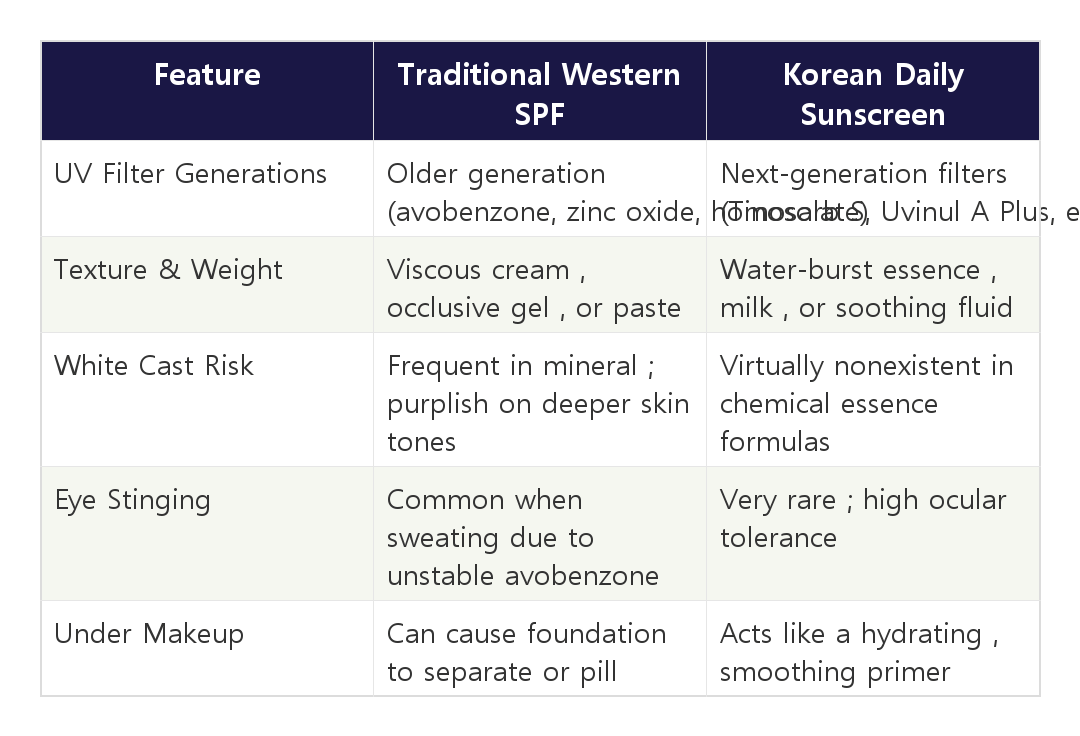
Western Sunscreen vs. Korean Daily SPF: At a Glance
Understanding the fundamental differences in formulation and performance makes the viral switch easy to see.

From our vanity: two Korean sunscreens
d’Alba UV Essence Waterfull+ Tone-Up Sun Cream (Pink Correcting), SPF 50+ PA++++. A tone-up sunscreen with Italian white truffle. d’Alba calls it a “pink dewy-glow” tone-up sun cream and says it has sold 10 million units worldwide. It gives skin a soft, brighter look, so it doubles as a base on no-makeup days.
Beauty of Joseon Daily Tinted Fluid Sunscreen, SPF 40 (US version). A mineral (zinc oxide) sunscreen with a sheer tint, in 12 shades. The brand’s own line: “Shields like SPF. Looks like tint. Feels like skincare.” Beauty of Joseon was named the world’s No. 1 K-beauty suncare brand in online sales for 2025 by Euromonitor.
Cult-Favorite Bottles Making the Biggest Waves
If you are looking to replace your current bottle, three specific formulas have earned immense global praise for their consistency and skin benefits.
- Beauty of Joseon Relief Sun (Rice + Probiotics): A creamy, nourishing formula packed with 30% rice extract and fermented grains. It leaves a natural dewy glow that dry to normal skin types fall in love with immediately.
- Skin1004 Madagascar Centella Hyalu-Cica Water-Fit Sun Serum: A whisper-light fluid that feels like splashing cool water onto your face. It is exceptional for combination or acne-prone skin that hates heavy layers.
- Round Lab Birch Juice Moisturizing Sun Cream: Enriched with birch tree sap and hyaluronic acid, this tube doubles seamlessly as a morning moisturizer for anyone rushing out the door.
You can search for these formulas on trusted global retailers or directly via the Olive Young Global homepage to explore verified user reviews and seasonal specials.

3 Practical Rules Before You Order
In Korea today, sun protection is treated with the same daily consistency as brushing your teeth. But as these products exploded in popularity across North America, shopping for them requires a bit of savvy.
In Korea, sun protection is treated as a daily necessity rather than something just for the beach.
First, always check the PA rating alongside the SPF number. SPF measures protection against UVB rays that cause sunburns, while the PA system (ranging from PA+ to PA++++) measures UVA protection against collagen damage and deep pigmentation. For maximum everyday defense, look for SPF 50+ and PA++++ on the front label.
Second, beware of counterfeit bottles on third-party marketplace platforms where unvetted resellers mix inventory. Purchase through dedicated Korean beauty distributors or verified beauty platforms to ensure you are receiving the actual formula.
Third, remember that most Korean daily sunscreens are designed for everyday city wear, not beach days. Unless a bottle specifically says “waterproof” or “leisure,” plan to stick with your water-resistant mineral sports lotion for heavy swimming sessions.
FAQ
Q. Are Korean sunscreens approved by the US FDA?
A. The specific advanced UV filters used in Korean sunscreens (like Uvinul and Tinosorb) are approved across Korea, the European Union, and Australia, but the US FDA has not updated its monograph to include them. This is why you will not find them on standard American pharmacy shelves, though they are completely legal to buy for personal import.
Q. Do Korean sunscreens leave a white cast on deeper skin tones?
A. Most chemical-based Korean sun serums melt into an entirely clear finish, making them beloved by people of color who struggle with the chalky ghost mask left by Western mineral SPFs. Just be sure to choose a chemical formula rather than a physical (mineral) one.
Q. Can I skip my morning moisturizer if I use a Korean sunscreen?
A. Yes, many people do. Formulas containing hyaluronic acid, birch juice, or fermented rice provide plenty of hydration for oily and combination skin types, letting you streamline your morning routine down to a gentle cleanser and your SPF.
Summary
- Korean sunscreens use modern, photostable UV filters that do not require thick oils or leave a stubborn white cast.
- Formulated as functional skincare, they absorb instantly like light serums and work beautifully under foundation without pilling.
- Always verify authentic sellers when ordering and look for SPF 50+ alongside a PA++++ rating for complete broad-spectrum defense.
Where to buy — Sister Unice’s picks
Disclosure: Some links in this post are affiliate links. If you buy through them, I may earn a small commission at no extra cost to you. As an Amazon Associate I earn from qualifying purchases.
The exact items I’d point a friend to, with the link to buy:
- Round Lab Birch Juice Moisturizing UV LOCK SPF 45 (the US version) — Has a lotion-like texture that can replace your daily moisturizer.
- Beauty of Joseon Relief Sun : Rice + Probiotics SPF50+ PA++++ — Its rice-extract formula leaves zero white cast, even on deep skin tones.
- SKIN1004 Madagascar Centella Hyalu-Cica Water-Fit Sun Serum — Has a ‘water-fit’ serum texture that feels weightless and contains soothing Centella Asiatica for sensitive skin.
- Haruharu Wonder Black Rice Moisture Airyfit Daily Sunscreen — The top choice for those seeking a velvet-matte finish, avoiding the greasiness often associated with Western chemical sunscreens.
- Anua Heartleaf Silky Moisture Sunscreen SPF50+ PA++++ — A trending pick for acne-prone skin, specifically formulated with Heartleaf to reduce redness while providing high UVA/UVB protection.
Links go to third-party booking/shopping sites. I only list places and products with genuinely strong reviews.
Unice recommends this as the gold standard because it successfully bridges the gap between high-tech sun protection and a premium daily moisturizer without any ‘sunscreen smell’.
As an affiliate, I may earn a small commission from purchases — at no extra cost to you.
Sources
- U.S. Food and Drug Administration (FDA) — Information on over-the-counter drug monographs and regulatory processes for sunscreen active ingredients.
- Ministry of Food and Drug Safety (MFDS, South Korea) — Official regulatory standards and functional cosmetic approval guidelines for UV protection.
- American Academy of Dermatology (AAD) — Clinical guidance on broad-spectrum UV protection, photostability, and daily SPF application.
Leave a Reply